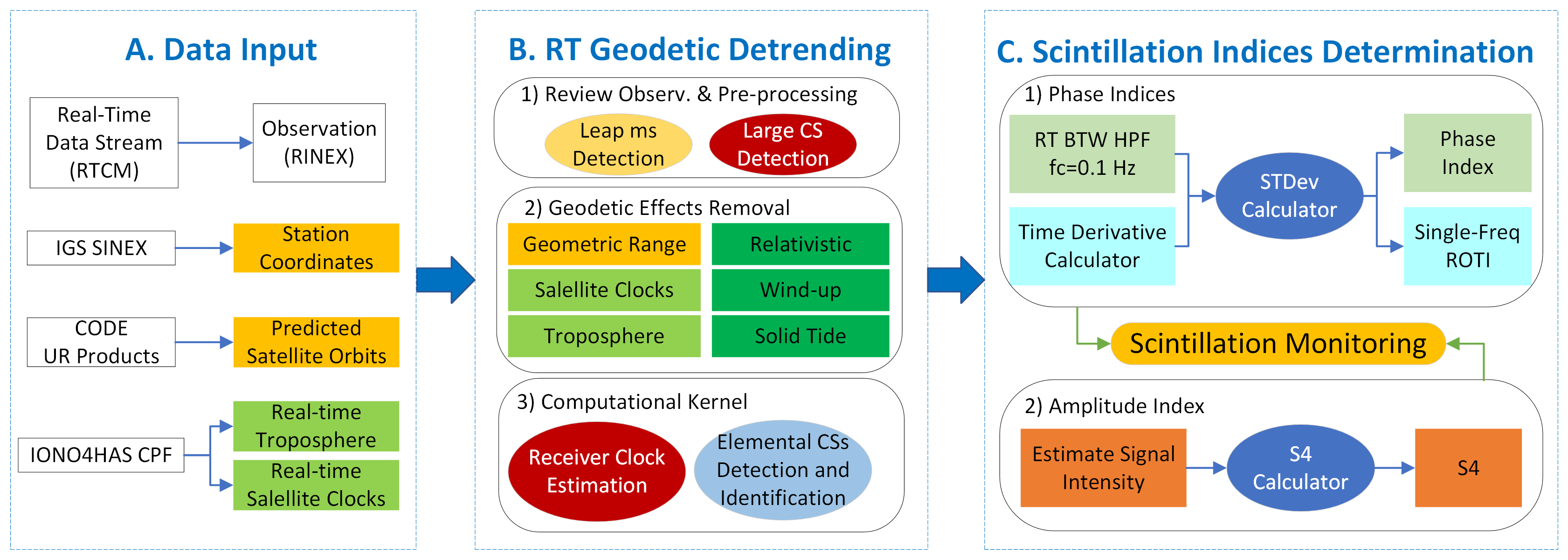
Diagram Illustrating the Main Steps of the RT-WMIS Implementation
The approach followed to implement the RT-WMIS is based on modifying the algorithms used by the post-process geodetic detrending (GD) methodology (developed in [RD-1] and [RD-2]) to work according to a real-time (RT) processing of the input GNSS carrier-phase measurements and, eventually, of the precise RT corrections required to model and detrend those measurements.
The outline of the different steps of the RT implementation can be seen in the figure above, which includes the following three steps:
Step 1: Data Collection
By means of some multi-stream client program, the RT 1-Hz data streams received from previously selected broadcasters (using an NTRIP transport protocol) are collected into RINEX format observation files. The preferred choice to do this conversion was the BKG NTRIP Client (BNC) software. Moreover, the data from precise receiver coordinates, satellite orbits and clocks and from zenith tropospheric delay (ZTD) corrections are also collected from some RT parallel processing or download from some service provider in the case of the precise coordinates of receivers and satellites.
Step 2: Pre-Processing
This is the main part of the processing. The raw carrier phase and code pseudorange measurements from two different frequencies in the RINEX files are revised to check for shifts in the time stamps due to millisecond corrections and any other anomalies in the input data. In this step, a rough cycle-slip (CS) detector is used at the beginning to specifically remove large discontinuities producing big jumps in the carrier-phase signals, which cannot be modelled by a small number of integer cycles of the GNSS signal. Finally, the output is converted to a standard text file.
Step 3: Detrending and Scintillation Index Calculation
From this text file, the code and carrier-phases are detrended in parallel, removing on one side the non-dispersive terms and known effects on the signals by means of precise geodetic products or by using standard model equations. Moreover, the clock fluctuations from the receiver are derived from a specific processing based on the GD method [RD-2]. After the detrending, one obtains the prefit residuals of uncombined GNSS signals only affected by the ionospheric delay and the carrier phase ambiguity.
After this detrending of the GNSS measurements, the RT-WMIS algorithm will proceed with the detection and correction of the elemental CSs not previously detected. This procedure is aimed at deriving the exact integer number of cycles that each individual GNSS signal changes as a consequence of a CS producing a small jump (of only a few cycles) in the detrended observables. Then, the individual arcs of continuous carrier-phase measurements from a single signal, free of CSs, will be identified and numbered. In this way, the final consolidated continuous arcs of measurements are free of any CS that could contaminate the calculation of scintillation parameters, which would give rise to artificial fluctuations not related with real ionospheric variability.
Using the consolidated arcs of detrended measurements, the last step of the RT-WMIS implementation is to calculate the amplitude scintillation index (S4) and the rate of total electron content index (ROTI). Additionally, after applying a 6th-order Butterworth high-pass filter (HPF) with a cut-off frequency of 0.1 Hz to the detrended L1-frequency carrier phase, the corresponding phase scintillation index is calculated.
References
Juan, J.M., Aragon-Angel, A., Sanz J., González-Casado G., Rovira-Garcia A. (2017) "A method for scintillation characterization using geodetic receivers operating at 1 Hz" Journal of Geodesy, November 2017, Volume 91, Issue 11, pp 1383–1397. DOI
Nguyen VK, Rovira-Garcia A, Juan JM, Sanz J, González-Casado G, La‐The V, Tung TH (2019) "Measuring phase scintillation at different frequencies with conventional GNSS receivers operating at 1 Hz" Journal of Geodesy 93(10):1985-2001. DOI
Yin Y, González-Casado G, Aragon-Angel A, Juan JM, Sanz J, Rovira-Garcia A (2024) "Advantages of Computing ROTI From Single-Frequency L1 Carrier-Phase Measurements of Geodetic Receivers Operating at 1 Hz" IEEE Transaction on Geoscience and Remote Sensing vol. 62, pp. 1-10, 2024, DOI